
Anxiety is one of the most common complaints people have today. It affects their focus, health, sleep, and overall quality of life. While traditional treatments such as medication and cognitive behavioral therapy (CBT) are widely used, research shows that hypnosis is an extremely powerful, evidence-based option to reduce or even eliminate anxiety, calm the nerves, and greatly improve one’s emotional well-being.
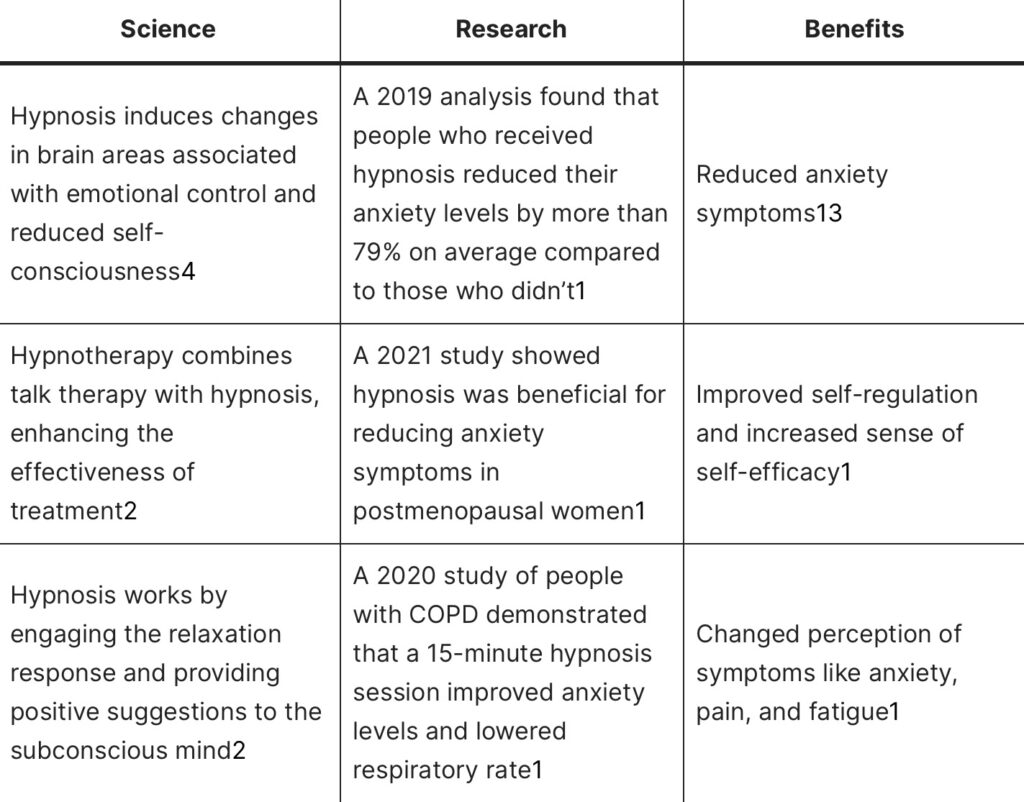
Over the last twenty years, leading universities, clinics, and medical organizations, including the Mayo Clinic, American Psychological Association (APA), and multiple peer-reviewed journals, have published studies that confirm hypnosis is more than just relaxation. In fact, it helps regulate emotions, quiet racing thoughts, and create measurable changes in both the brain and body.
Meta-analyses show significant reductions in anxiety, and trials demonstrate hypnosis lowers hot flashes, eases pain, and improves sleep. The science is clear: hypnosis is a valuable therapeutic approach that offers safe, natural, and lasting results. Many researchers even highlight it as a cost-effective, non-addictive alternative or complement to medication.
In this article, we will explore the most compelling research on hypnotherapy for anxiety and other issues. You can see for yourself why hypnosis is being embraced by doctors, psychologists, and patients alike as a reliable, effective tool for relief around the world.
Scientific Evidence: Does Hypnotherapy Really Work for Anxiety and other issues?
Research has provided strong evidence supporting hypnotherapy as an effective tool for anxiety relief.
A meta-analysis in the International Journal of Clinical and Experimental Hypnosis found that hypnotherapy significantly reduced anxiety levels in participants compared to control groups. The best results occurred when hypnosis was combined with other therapies like cognitive behavioral therapy (CBT).
A study in Expert Review of Neurotherapeutics highlighted that self-hypnosis training is a fast, cost-effective, non-addictive alternative to medication for anxiety disorders. This research emphasized that hypnotherapy helps patients regulate emotions and reduce stress-related symptoms.
PubMed https://pubmed.ncbi.nlm.nih.gov/20136382/
The Mayo Clinic recognizes hypnosis as a safe and effective technique for reducing stress, improving sleep, and easing symptoms of anxiety and post-traumatic stress disorder (PTSD).
https://www.mayoclinic.org/tests-procedures/hypnosis/about/pac-20394405?utm_source=chatgpt.com
The American Psychological Association publication vol. 55 No. 3 expresses research, supporting its effectiveness, as practitioners are embracing Hypnosis to treat certain conditions, such as anxiety “by changing a persons sense of authorship, the effort becomes external to them. Hypnosis kickstart the process by making it easier to change. “
“Hypnotherapy has some important advantages,” said Guy Montgomery, PhD, a professor of psychology and director of the Center for Behavioral Oncology at the Icahn School of Medicine at Mount Sinai in New York City, who uses and studies clinical hypnosis for reducing pain in cancer patients.
While responsiveness varies, however, most people can benefit from hypnosis to some degree, said Gary Elkins, PhD, ABPP, a professor of psychology and neuroscience at Baylor University.
Elkins’s research has indicated that clinical hypnosis may have benefits even in people who are not especially high in hypnotizability. In recent work, he’s tested a hypnotherapy intervention for treating hot flashes in menopausal women and breast cancer survivors. In one trial, menopausal women received five weekly sessions of clinical hypnosis or a structured-attention control intervention. Those in the hypnosis group reported hot flashes were reduced by more than 74%, whereas the control group reported a 17% reduction in hot flashes. Objective physiological monitoring of hot flashes supported their reports, showing a 57% reduction in hot flashes for women who had hypnosis compared with a 10% reduction for control participants ( Menopause , Vol. 20, No. 3, 2013 ).
Research suggests that hypnotic suggestion may be useful for a host of other behavioral health problems, including improving sleep, managing stress, and quitting smoking. One meta-analysis found, for instance, that hypnosis was a promising treatment for sleep problems (Chamine, I., et al., Journal of Clinical Sleep Medicine, Vol. 14, No. 2, 2018). And a meta-analysis of hypnosis for depression found that hypnosis appears to be an excellent treatment option for depression (Milling, L. S., et al., American Journal of Clinical Hypnosis, Vol. 61, No. 3, 2019).
“ It’s clear hypnosis has an important role to play as an adjunctive approach to psychotherapy,” Elkins said. And incorporating hypnosis into psychotherapeutic interventions might boost their benefit.
Researchers assessed 42 controlled studies of hypnosis for treating clinical pain. They concluded that hypnosis is “very efficacious,” with a mean weighted effect size in the medium range (Milling, L. S., et al., International Journal of Clinical and Experimental Hypnosis, Vol. 69, No. 3, 2021). “Hypnosis can help turn down the volume on pain, both acute and chronic,” Montgomery said. In his work with cancer patients, he has demonstrated its benefit in a series of clinical trials—including a forthcoming study suggesting that hypnosis could reduce the joint pain that is a common side effect of a drug used to treat breast cancer. His program has funding from the National Cancer Institute to provide free training to any cancer care providers who want to learn hypnosis to help patients manage pain.
“Hypnosis works. And the cool thing is that in our randomized trials, we don’t find effects due to race or ethnicity. This is something that can help anybody,” said Montgomery.
Bottom Line: Hypnotherapy has been scientifically proven to lower anxiety symptoms, stress hormones, and emotional reactivity, making it a promising therapy as well as complementary to medical.